Economic losses are piling up, impacting all stakeholders.
Transition is key to prosperity, and likely the least costly scenario.
Social risks/issues are closely interlinked with geopolitical and economic risks.
Tension between capital and labor is increasing.
Companies and/or investors may not be prepared and convinced by the urgency of the climate risk situation.
Policy makers and the asset management industry are gradually understanding the urgency and aligning across geographies and stakeholders. However, the alignment should be accelerated.
Sustainable finance (ESG 2.0) will play a key role in the future.
In conclusion on ESG, Mr De Coensel mentioned that: On Environment: Urgent action is required. Both the investment challenges and opportunities are present across geographies and likely most favourable under a 1.5°C scenario. On Social: Social issues are increasingly integrated in sustainable investment concepts and regulation, interlinked with economic/geopolitical risks. On Governance: Current investment in environment fields requires proper knowledge and integration by boards and investors.
And finally, this first part finished with 3 important take-aways:
Capital markets need to continue the journey to mobilize… innovate, improve, revise, increase! ESG 2.0 is a continuously evolving concept.
ESG pushback school has no merit – comprehensive ESG factor integration is becoming mainstream, part of the duty of care and the fiduciary duty.
Data availability and quality will accelerate across financial and non-financial corporates, enhancing ESG risk and opportunities management.
Following this introductory presentation, a panel discussion was moderated by Alexandra Tracy, Founder and President of Hoi Ping Ventures, which provides research and consulting on investment in low-carbon energy and infrastructure in Asian emerging markets. In addition to Peter De Coensel, the following people took part in the panel:
Frank Vandenborre, Group Director Sustainability, AGEAS insurance group.
Qian Li, Senior Corporate Communication Director, ABInbev beer conglomerate.
Diana Tang, Director, Sustainable Finance, Asia Pacific, ING bank.
The panel started by giving an overview of the current status of sustainable finance in Asia and globally, and what needs to be done to scale up sustainable financing flows. When speaking about product innovation tomobilize sustainable capital, the panel referred to “blended finance” – bringing together capital from public institutions, like development banks, together with the private sector to finance projects. Finally, the participants covered the accusations of greenwashing (claiming too much) and greenhushing (not saying anything) about the financial institutions’ sustainability credentials.
In the third and final part, the audience listened to the keynote speech on Climate and the International Organisation of Securities Commissions by Jean-Paul Servais. He mentioned that the International Sustainability Standards Board’s standards were “fit for purpose” and had responded to the demand from ordinary investors (so-called John and Mary) and from fund managers for more certainty on companies’ sustainability claims to stamp out greenwashing. In fact, the goal is to reach the same standards that apply to financial reporting to sustainability requirements. By implementing those rigorous standards, IOSCO will help investors get access to better data to evaluate the risks that changes in the climate are creating to businesses.
This speech was followed by a fireside chat with Julia Leung, CEO of The Securities and Futures Commission (SFC) of Hong Kong and Jean-Paul Servais (FSMA* – IOSCO*), moderated by Mushtaq Kapasi, Managing Director and Chief Representative for Asia-Pacific of the International Capital Market Association (ICMA). SFC, established in 1989, is an independent statutory body that regulates Hong Kong’s securities and futures markets. In response to the questions by Mr Kapasi, Ms Leung declared that the SFC was looking closely at what regulators were doing on ESG standards, especially in Europe. She mentioned also that markets and countries are not equal and do not have the same needs. Consequently, the ESG standards must be flexible enough to allow listed companies and SMEs to respond to the questions of the investors in that field.
The seminar ended by gathering in separate “one to one” or small group talks.
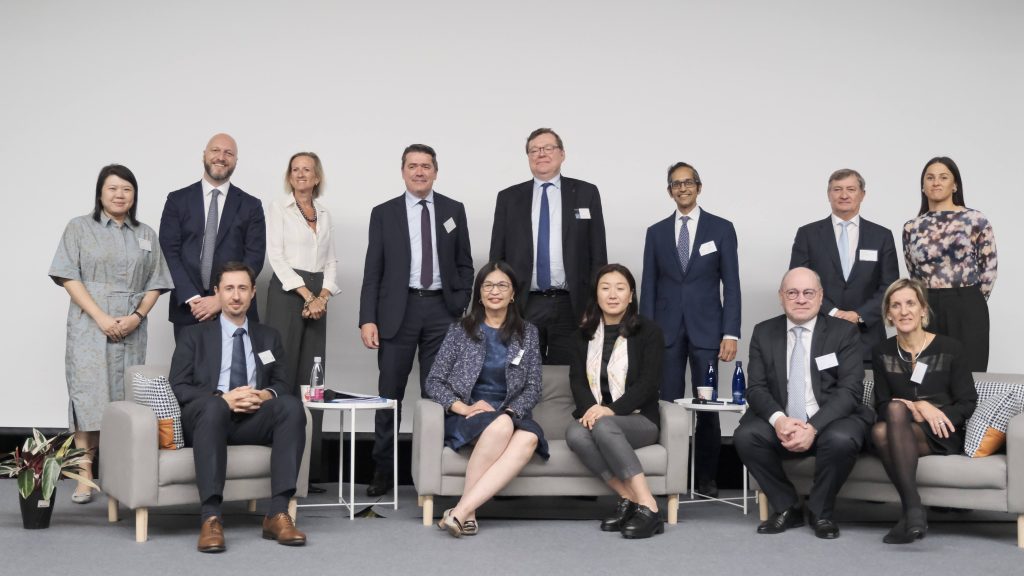
Group photo of the various speakers at the Climate and ESG seminar and BLCC members, 17 Nov 2023 in The Qube, PMQ, Central, Hong Kong. From left to right back row: Ms Diana Tang, Mr Fred Radelet, Ms Alexander Tracy, Mr Peter De Coensel, Mr Jean Paul Servais, Mr Mushtaq Kapasi, Mr Patrice Thys, Ms Femke Debie. From left to right front row: Mr David Lomastro, Ms Julia Leung, Ms Qian Li, Mr Frank Vandenborre, Ms Katty Demeuleneere.
Patrice J. Thys
Chairman, The Belgium – Luxembourg Chamber of Commerce in Hong Kong
Economic losses are piling up, impacting all stakeholders.
Transition is key to prosperity, and likely the least costly scenario.
Social risks/issues are closely interlinked with geopolitical and economic risks.
Tension between capital and labor is increasing.
Companies and/or investors may not be prepared and convinced by the urgency of the climate risk situation.
Policy makers and the asset management industry are gradually understanding the urgency and aligning across geographies and stakeholders. However, the alignment should be accelerated.
Sustainable finance (ESG 2.0) will play a key role in the future.
In conclusion on ESG, Mr De Coensel mentioned that: On Environment: Urgent action is required. Both the investment challenges and opportunities are present across geographies and likely most favourable under a 1.5°C scenario. On Social: Social issues are increasingly integrated in sustainable investment concepts and regulation, interlinked with economic/geopolitical risks. On Governance: Current investment in environment fields requires proper knowledge and integration by boards and investors.
And finally, this first part finished with 3 important take-aways:
Capital markets need to continue the journey to mobilize… innovate, improve, revise, increase! ESG 2.0 is a continuously evolving concept.
ESG pushback school has no merit – comprehensive ESG factor integration is becoming mainstream, part of the duty of care and the fiduciary duty.
Data availability and quality will accelerate across financial and non-financial corporates, enhancing ESG risk and opportunities management.
Following this introductory presentation, a panel discussion was moderated by Alexandra Tracy, Founder and President of Hoi Ping Ventures, which provides research and consulting on investment in low-carbon energy and infrastructure in Asian emerging markets. In addition to Peter De Coensel, the following people took part in the panel:
Frank Vandenborre, Group Director Sustainability, AGEAS insurance group.
Qian Li, Senior Corporate Communication Director, ABInbev beer conglomerate.
Diana Tang, Director, Sustainable Finance, Asia Pacific, ING bank.
The panel started by giving an overview of the current status of sustainable finance in Asia and globally, and what needs to be done to scale up sustainable financing flows. When speaking about product innovation tomobilize sustainable capital, the panel referred to “blended finance” – bringing together capital from public institutions, like development banks, together with the private sector to finance projects. Finally, the participants covered the accusations of greenwashing (claiming too much) and greenhushing (not saying anything) about the financial institutions’ sustainability credentials.
In the third and final part, the audience listened to the keynote speech on Climate and the International Organisation of Securities Commissions by Jean-Paul Servais. He mentioned that the International Sustainability Standards Board’s standards were “fit for purpose” and had responded to the demand from ordinary investors (so-called John and Mary) and from fund managers for more certainty on companies’ sustainability claims to stamp out greenwashing. In fact, the goal is to reach the same standards that apply to financial reporting to sustainability requirements. By implementing those rigorous standards, IOSCO will help investors get access to better data to evaluate the risks that changes in the climate are creating to businesses.
This speech was followed by a fireside chat with Julia Leung, CEO of The Securities and Futures Commission (SFC) of Hong Kong and Jean-Paul Servais (FSMA* – IOSCO*), moderated by Mushtaq Kapasi, Managing Director and Chief Representative for Asia-Pacific of the International Capital Market Association (ICMA). SFC, established in 1989, is an independent statutory body that regulates Hong Kong’s securities and futures markets. In response to the questions by Mr Kapasi, Ms Leung declared that the SFC was looking closely at what regulators were doing on ESG standards, especially in Europe. She mentioned also that markets and countries are not equal and do not have the same needs. Consequently, the ESG standards must be flexible enough to allow listed companies and SMEs to respond to the questions of the investors in that field.
The seminar ended by gathering in separate “one to one” or small group talks.
Group photo of the various speakers at the Climate and ESG seminar and BLCC members, 17 Nov 2023 in The Qube, PMQ, Central, Hong Kong. From left to right back row: Ms Diana Tang, Mr Fred Radelet, Ms Alexander Tracy, Mr Peter De Coensel, Mr Jean Paul Servais, Mr Mushtaq Kapasi, Mr Patrice Thys, Ms Femke Debie. From left to right front row: Mr David Lomastro, Ms Julia Leung, Ms Qian Li, Mr Frank Vandenborre, Ms Katty Demeuleneere.
Patrice J. Thys
Chairman, The Belgium – Luxembourg Chamber of Commerce in Hong Kong
The Belgium Luxembourg Chamber of Commerce in HK (BLCC) organises a Belgian Business Seminar (BBS) on a yearly basis. During Covid, this was not easy, but we were able to organise a seminar on logistics in Belgium with representatives from Alibaba as guest company. This year, the BLCC took on an extra challenge and extended the BBS to a full day by organizing two half-day seminars (see below). The seminars were supported financially by 5 sponsors: The Federal Public Service Foreign Affairs, Foreign Trade and Development Cooperation of the Kingdom of Belgium, Flanders Investment and Trade (FIT), Invest HK, Syncicap Wealth Management and Alea Insurances. The event took place on Friday November 17th from 8.30am to 4.30pm at PMQ in Central, Hong Kong and was part of the “Belgian Days”– a glimpse of Belgian culture, vibes and delights, organized by the Consulate General of Belgium in Hong Kong.
From the reactions received during and after the two seminars, the public was enthusiastic about the outcome and take-aways from both seminars.
The BLCC is committed to organising a similar Belgian Business Seminar event in 2024.
The Life Sciences Sector in Hong Kong and Belgium
The topic of the morning seminar of this year’s BBS was “Life Sciences in Hong Kong & Belgium: Current R&D developments, collaboration projects and cooperation opportunities”. Approximately 70 people attended the 3-hour session, during which 11 speakers from both Hong Kong and Belgium presented on various aspects of the Life Sciences field.
H.E. the Consul General of Belgium, David Lomastro, started the session by welcoming the audience, explaining the spirit of the Belgian Days and emphasizing the strength of Belgium in Life Sciences and specially in R&D.
The importance of the Life Sciences sector in both Belgium and Hong Kong was presented by Mr. Patrice Thys, Chairman of the BLCC and Founder of Asia-Euro Consultancy Ltd (HK); Mr. Peter Tanghe, Science & Technology Counsellor for Flanders Investment & Trade; and Mr. Andy Wong, Head of Innovation and Technology at InvestHK.
Among, others, the audience was informed of Belgium’s vital role in global health during the Covid crisis with the production of the Pfizer Cov-19 vaccine, which was distributed throughout Europe and other parts of the world. According to a recent OECD report, Belgium has the second-highest level of pharma R&D investment per inhabitant within Europe. In Hong Kong, biotechnology R&D and fund-raising are at the center of the Chief Executive’s 2022 and 2023 policy address, showing the importance of the sector for the future economy of the city.
Grace Lau, Head of the Institute of Translational Research at the Hong Kong Science and Technology Park (HKSTP), showed the commitment of the Hong Kong Authorities for R&D in Life Sciences and the actual stage of development of the various parks under the administration of HKSTP. The next part of the Life Sciences seminar was about the collaborations between Belgium and Hong Kong in the field of Life Sciences.
Lydia Leung, CEO of Belun Technology and Chairperson at the Hong Kong Medical and Healthcare Device Industries Association, presented the results of Belun’s close partnership with Studio Dott, a Belgian company involved in design and marketing in the Life Sciences industry. Pieter Lesage, CEO of Studio Dott explained Studio’s Dott philosophy prioritizing user research and co-creation.
Wu Yawen, CEO at China Resources – Verlinvest Nursing homes JV, showed the audience how a nursing home management system from Belgium was successfully imported in 2015 and used to develop a nursing home platform, which today is the industry leader in China.
Through another partnership led by the conglomerate China Resources (corporate member of the BLCC), Professor Denis Dufrane, CEO of Novadip, and Dr Zhou Yi, CEO of the CR-CP Life Science Fund, explained the development of Novadip in addressing some of today’s biggest challenges in bone and tissue regenerative medicine.
Tony Sun, Greater China Medical Sales manager at Materialise, showed how a Belgian company is successful on the Chinese market with its technology in 3D printing and additive manufacturing.
Finally, Professor Denis Dufrane, founder of Texere, presented the details of the world’s first fully robotic line offering revolutionary improvements in the processing of human tissue. Professor Dufrane also explained how this technology can be brought to Hong Kong, Mainland China and to the rest of Asia through local partnerships.
After the seminar, speakers and the audience met in small groups to further discuss potential collaborations.
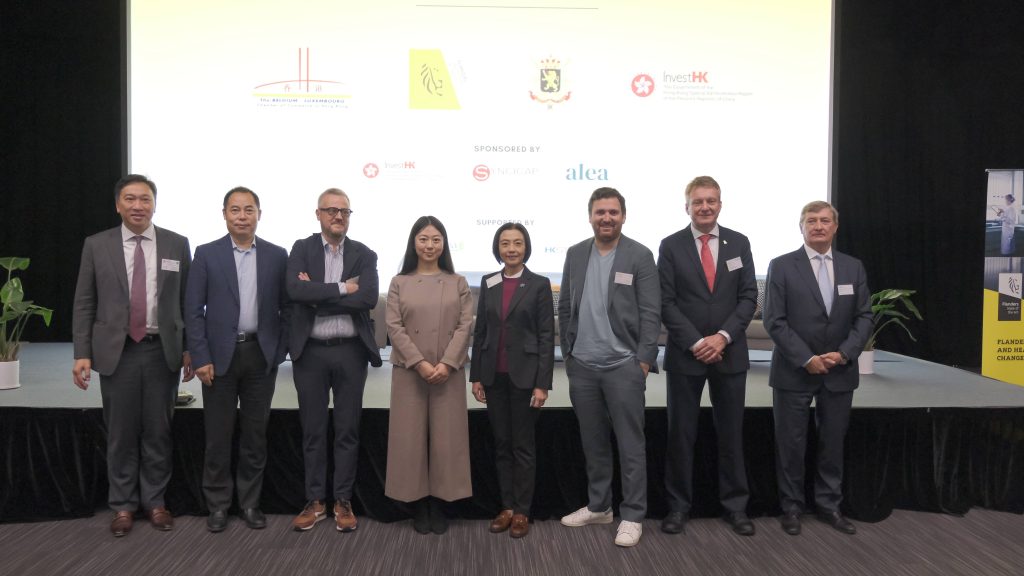
Group photo of some of the speakers at the Life Science seminar, 17 Nov 2023 in The Qube, PMQ, Central, Hong Kong. From left to right: Mr Andy Wong, Dr Zhou Yi, Mr Denis Dufrane, Ms Wu Yawen, Ms Grace Lau, Mr Pieter Lesage, Mr Peter Tanghe, Mr Patrice Thys.
Climate and ESG – Perspective from the Belgian and HK Finance & Corporate sector
The topic of the afternoon seminar of the BBS 2023 was on “Climate and ESG – A perspective from the Belgian and Hong Kong finance & corporate sector and regulators”. Not only has Europe taken a leading role in Climate and ESG; additionally, Mr. Jean Paul Servais, the Chairman of the International Organization of Securities Commissions (IOSCO) is from Belgium. IOSCO, established in 1983, is the international body that brings together the world’s securities regulators and is recognized as the global standard setter for the securities sector. Mr Servais is also the Chairman of the FSMA in Belgium, i.e. the Belgian financial markets, products and conduct supervisor.
H.E. the Consul General of Belgium, David Lomastro, opened the seminar by stressing the urgent nature of the challenges, Belgium’s openness to cooperation and the importance of regulation as a vector of trust in a more fragmented world.
More than 110 people attended this seminar, which consisted of 3 parts:
First, a presentation on ESG 2.0,
Followed by a panel discussion, and
Finally, a keynote speech with a fireside chat.
The presentation on ESG 2.0 was made by Peter De Coensel, CEO of Degroof Petercam Asset Management, who came from Belgium specifically to address the audience. He emphasized the fact that:
Economic losses are piling up, impacting all stakeholders.
Transition is key to prosperity, and likely the least costly scenario.
Social risks/issues are closely interlinked with geopolitical and economic risks.
Tension between capital and labor is increasing.
Companies and/or investors may not be prepared and convinced by the urgency of the climate risk situation.
Policy makers and the asset management industry are gradually understanding the urgency and aligning across geographies and stakeholders. However, the alignment should be accelerated.
Sustainable finance (ESG 2.0) will play a key role in the future.
In conclusion on ESG, Mr De Coensel mentioned that: On Environment: Urgent action is required. Both the investment challenges and opportunities are present across geographies and likely most favourable under a 1.5°C scenario. On Social: Social issues are increasingly integrated in sustainable investment concepts and regulation, interlinked with economic/geopolitical risks. On Governance: Current investment in environment fields requires proper knowledge and integration by boards and investors.
And finally, this first part finished with 3 important take-aways:
Capital markets need to continue the journey to mobilize… innovate, improve, revise, increase! ESG 2.0 is a continuously evolving concept.
ESG pushback school has no merit – comprehensive ESG factor integration is becoming mainstream, part of the duty of care and the fiduciary duty.
Data availability and quality will accelerate across financial and non-financial corporates, enhancing ESG risk and opportunities management.
Following this introductory presentation, a panel discussion was moderated by Alexandra Tracy, Founder and President of Hoi Ping Ventures, which provides research and consulting on investment in low-carbon energy and infrastructure in Asian emerging markets. In addition to Peter De Coensel, the following people took part in the panel:
Frank Vandenborre, Group Director Sustainability, AGEAS insurance group.
Qian Li, Senior Corporate Communication Director, ABInbev beer conglomerate.
Diana Tang, Director, Sustainable Finance, Asia Pacific, ING bank.
The panel started by giving an overview of the current status of sustainable finance in Asia and globally, and what needs to be done to scale up sustainable financing flows. When speaking about product innovation tomobilize sustainable capital, the panel referred to “blended finance” – bringing together capital from public institutions, like development banks, together with the private sector to finance projects. Finally, the participants covered the accusations of greenwashing (claiming too much) and greenhushing (not saying anything) about the financial institutions’ sustainability credentials.
In the third and final part, the audience listened to the keynote speech on Climate and the International Organisation of Securities Commissions by Jean-Paul Servais. He mentioned that the International Sustainability Standards Board’s standards were “fit for purpose” and had responded to the demand from ordinary investors (so-called John and Mary) and from fund managers for more certainty on companies’ sustainability claims to stamp out greenwashing. In fact, the goal is to reach the same standards that apply to financial reporting to sustainability requirements. By implementing those rigorous standards, IOSCO will help investors get access to better data to evaluate the risks that changes in the climate are creating to businesses.
This speech was followed by a fireside chat with Julia Leung, CEO of The Securities and Futures Commission (SFC) of Hong Kong and Jean-Paul Servais (FSMA* – IOSCO*), moderated by Mushtaq Kapasi, Managing Director and Chief Representative for Asia-Pacific of the International Capital Market Association (ICMA). SFC, established in 1989, is an independent statutory body that regulates Hong Kong’s securities and futures markets. In response to the questions by Mr Kapasi, Ms Leung declared that the SFC was looking closely at what regulators were doing on ESG standards, especially in Europe. She mentioned also that markets and countries are not equal and do not have the same needs. Consequently, the ESG standards must be flexible enough to allow listed companies and SMEs to respond to the questions of the investors in that field.
The seminar ended by gathering in separate “one to one” or small group talks.
Group photo of the various speakers at the Climate and ESG seminar and BLCC members, 17 Nov 2023 in The Qube, PMQ, Central, Hong Kong. From left to right back row: Ms Diana Tang, Mr Fred Radelet, Ms Alexander Tracy, Mr Peter De Coensel, Mr Jean Paul Servais, Mr Mushtaq Kapasi, Mr Patrice Thys, Ms Femke Debie. From left to right front row: Mr David Lomastro, Ms Julia Leung, Ms Qian Li, Mr Frank Vandenborre, Ms Katty Demeuleneere.
Patrice J. Thys
Chairman, The Belgium – Luxembourg Chamber of Commerce in Hong Kong
Economic losses are piling up, impacting all stakeholders.
Transition is key to prosperity, and likely the least costly scenario.
Social risks/issues are closely interlinked with geopolitical and economic risks.
Tension between capital and labor is increasing.
Companies and/or investors may not be prepared and convinced by the urgency of the climate risk situation.
Policy makers and the asset management industry are gradually understanding the urgency and aligning across geographies and stakeholders. However, the alignment should be accelerated.
Sustainable finance (ESG 2.0) will play a key role in the future.
In conclusion on ESG, Mr De Coensel mentioned that: On Environment: Urgent action is required. Both the investment challenges and opportunities are present across geographies and likely most favourable under a 1.5°C scenario. On Social: Social issues are increasingly integrated in sustainable investment concepts and regulation, interlinked with economic/geopolitical risks. On Governance: Current investment in environment fields requires proper knowledge and integration by boards and investors.
And finally, this first part finished with 3 important take-aways:
Capital markets need to continue the journey to mobilize… innovate, improve, revise, increase! ESG 2.0 is a continuously evolving concept.
ESG pushback school has no merit – comprehensive ESG factor integration is becoming mainstream, part of the duty of care and the fiduciary duty.
Data availability and quality will accelerate across financial and non-financial corporates, enhancing ESG risk and opportunities management.
Following this introductory presentation, a panel discussion was moderated by Alexandra Tracy, Founder and President of Hoi Ping Ventures, which provides research and consulting on investment in low-carbon energy and infrastructure in Asian emerging markets. In addition to Peter De Coensel, the following people took part in the panel:
Frank Vandenborre, Group Director Sustainability, AGEAS insurance group.
Qian Li, Senior Corporate Communication Director, ABInbev beer conglomerate.
Diana Tang, Director, Sustainable Finance, Asia Pacific, ING bank.
The panel started by giving an overview of the current status of sustainable finance in Asia and globally, and what needs to be done to scale up sustainable financing flows. When speaking about product innovation tomobilize sustainable capital, the panel referred to “blended finance” – bringing together capital from public institutions, like development banks, together with the private sector to finance projects. Finally, the participants covered the accusations of greenwashing (claiming too much) and greenhushing (not saying anything) about the financial institutions’ sustainability credentials.
In the third and final part, the audience listened to the keynote speech on Climate and the International Organisation of Securities Commissions by Jean-Paul Servais. He mentioned that the International Sustainability Standards Board’s standards were “fit for purpose” and had responded to the demand from ordinary investors (so-called John and Mary) and from fund managers for more certainty on companies’ sustainability claims to stamp out greenwashing. In fact, the goal is to reach the same standards that apply to financial reporting to sustainability requirements. By implementing those rigorous standards, IOSCO will help investors get access to better data to evaluate the risks that changes in the climate are creating to businesses.
This speech was followed by a fireside chat with Julia Leung, CEO of The Securities and Futures Commission (SFC) of Hong Kong and Jean-Paul Servais (FSMA* – IOSCO*), moderated by Mushtaq Kapasi, Managing Director and Chief Representative for Asia-Pacific of the International Capital Market Association (ICMA). SFC, established in 1989, is an independent statutory body that regulates Hong Kong’s securities and futures markets. In response to the questions by Mr Kapasi, Ms Leung declared that the SFC was looking closely at what regulators were doing on ESG standards, especially in Europe. She mentioned also that markets and countries are not equal and do not have the same needs. Consequently, the ESG standards must be flexible enough to allow listed companies and SMEs to respond to the questions of the investors in that field.
The seminar ended by gathering in separate “one to one” or small group talks.
Group photo of the various speakers at the Climate and ESG seminar and BLCC members, 17 Nov 2023 in The Qube, PMQ, Central, Hong Kong. From left to right back row: Ms Diana Tang, Mr Fred Radelet, Ms Alexander Tracy, Mr Peter De Coensel, Mr Jean Paul Servais, Mr Mushtaq Kapasi, Mr Patrice Thys, Ms Femke Debie. From left to right front row: Mr David Lomastro, Ms Julia Leung, Ms Qian Li, Mr Frank Vandenborre, Ms Katty Demeuleneere.
Patrice J. Thys
Chairman, The Belgium – Luxembourg Chamber of Commerce in Hong Kong
Economic losses are piling up, impacting all stakeholders.
Transition is key to prosperity, and likely the least costly scenario.
Social risks/issues are closely interlinked with geopolitical and economic risks.
Tension between capital and labor is increasing.
Companies and/or investors may not be prepared and convinced by the urgency of the climate risk situation.
Policy makers and the asset management industry are gradually understanding the urgency and aligning across geographies and stakeholders. However, the alignment should be accelerated.
Sustainable finance (ESG 2.0) will play a key role in the future.
In conclusion on ESG, Mr De Coensel mentioned that: On Environment: Urgent action is required. Both the investment challenges and opportunities are present across geographies and likely most favourable under a 1.5°C scenario. On Social: Social issues are increasingly integrated in sustainable investment concepts and regulation, interlinked with economic/geopolitical risks. On Governance: Current investment in environment fields requires proper knowledge and integration by boards and investors.
And finally, this first part finished with 3 important take-aways:
Capital markets need to continue the journey to mobilize… innovate, improve, revise, increase! ESG 2.0 is a continuously evolving concept.
ESG pushback school has no merit – comprehensive ESG factor integration is becoming mainstream, part of the duty of care and the fiduciary duty.
Data availability and quality will accelerate across financial and non-financial corporates, enhancing ESG risk and opportunities management.
Following this introductory presentation, a panel discussion was moderated by Alexandra Tracy, Founder and President of Hoi Ping Ventures, which provides research and consulting on investment in low-carbon energy and infrastructure in Asian emerging markets. In addition to Peter De Coensel, the following people took part in the panel:
Frank Vandenborre, Group Director Sustainability, AGEAS insurance group.
Qian Li, Senior Corporate Communication Director, ABInbev beer conglomerate.
Diana Tang, Director, Sustainable Finance, Asia Pacific, ING bank.
The panel started by giving an overview of the current status of sustainable finance in Asia and globally, and what needs to be done to scale up sustainable financing flows. When speaking about product innovation tomobilize sustainable capital, the panel referred to “blended finance” – bringing together capital from public institutions, like development banks, together with the private sector to finance projects. Finally, the participants covered the accusations of greenwashing (claiming too much) and greenhushing (not saying anything) about the financial institutions’ sustainability credentials.
In the third and final part, the audience listened to the keynote speech on Climate and the International Organisation of Securities Commissions by Jean-Paul Servais. He mentioned that the International Sustainability Standards Board’s standards were “fit for purpose” and had responded to the demand from ordinary investors (so-called John and Mary) and from fund managers for more certainty on companies’ sustainability claims to stamp out greenwashing. In fact, the goal is to reach the same standards that apply to financial reporting to sustainability requirements. By implementing those rigorous standards, IOSCO will help investors get access to better data to evaluate the risks that changes in the climate are creating to businesses.
This speech was followed by a fireside chat with Julia Leung, CEO of The Securities and Futures Commission (SFC) of Hong Kong and Jean-Paul Servais (FSMA* – IOSCO*), moderated by Mushtaq Kapasi, Managing Director and Chief Representative for Asia-Pacific of the International Capital Market Association (ICMA). SFC, established in 1989, is an independent statutory body that regulates Hong Kong’s securities and futures markets. In response to the questions by Mr Kapasi, Ms Leung declared that the SFC was looking closely at what regulators were doing on ESG standards, especially in Europe. She mentioned also that markets and countries are not equal and do not have the same needs. Consequently, the ESG standards must be flexible enough to allow listed companies and SMEs to respond to the questions of the investors in that field.
The seminar ended by gathering in separate “one to one” or small group talks.
Group photo of the various speakers at the Climate and ESG seminar and BLCC members, 17 Nov 2023 in The Qube, PMQ, Central, Hong Kong. From left to right back row: Ms Diana Tang, Mr Fred Radelet, Ms Alexander Tracy, Mr Peter De Coensel, Mr Jean Paul Servais, Mr Mushtaq Kapasi, Mr Patrice Thys, Ms Femke Debie. From left to right front row: Mr David Lomastro, Ms Julia Leung, Ms Qian Li, Mr Frank Vandenborre, Ms Katty Demeuleneere.
Patrice J. Thys
Chairman, The Belgium – Luxembourg Chamber of Commerce in Hong Kong
The Belgium Luxembourg Chamber of Commerce in HK (BLCC) organises a Belgian Business Seminar (BBS) on a yearly basis. During Covid, this was not easy, but we were able to organise a seminar on logistics in Belgium with representatives from Alibaba as guest company. This year, the BLCC took on an extra challenge and extended the BBS to a full day by organizing two half-day seminars (see below). The seminars were supported financially by 5 sponsors: The Federal Public Service Foreign Affairs, Foreign Trade and Development Cooperation of the Kingdom of Belgium, Flanders Investment and Trade (FIT), Invest HK, Syncicap Wealth Management and Alea Insurances. The event took place on Friday November 17th from 8.30am to 4.30pm at PMQ in Central, Hong Kong and was part of the “Belgian Days”– a glimpse of Belgian culture, vibes and delights, organized by the Consulate General of Belgium in Hong Kong.
From the reactions received during and after the two seminars, the public was enthusiastic about the outcome and take-aways from both seminars.
The BLCC is committed to organising a similar Belgian Business Seminar event in 2024.
The Life Sciences Sector in Hong Kong and Belgium
The topic of the morning seminar of this year’s BBS was “Life Sciences in Hong Kong & Belgium: Current R&D developments, collaboration projects and cooperation opportunities”. Approximately 70 people attended the 3-hour session, during which 11 speakers from both Hong Kong and Belgium presented on various aspects of the Life Sciences field.
H.E. the Consul General of Belgium, David Lomastro, started the session by welcoming the audience, explaining the spirit of the Belgian Days and emphasizing the strength of Belgium in Life Sciences and specially in R&D.
The importance of the Life Sciences sector in both Belgium and Hong Kong was presented by Mr. Patrice Thys, Chairman of the BLCC and Founder of Asia-Euro Consultancy Ltd (HK); Mr. Peter Tanghe, Science & Technology Counsellor for Flanders Investment & Trade; and Mr. Andy Wong, Head of Innovation and Technology at InvestHK.
Among, others, the audience was informed of Belgium’s vital role in global health during the Covid crisis with the production of the Pfizer Cov-19 vaccine, which was distributed throughout Europe and other parts of the world. According to a recent OECD report, Belgium has the second-highest level of pharma R&D investment per inhabitant within Europe. In Hong Kong, biotechnology R&D and fund-raising are at the center of the Chief Executive’s 2022 and 2023 policy address, showing the importance of the sector for the future economy of the city.
Grace Lau, Head of the Institute of Translational Research at the Hong Kong Science and Technology Park (HKSTP), showed the commitment of the Hong Kong Authorities for R&D in Life Sciences and the actual stage of development of the various parks under the administration of HKSTP. The next part of the Life Sciences seminar was about the collaborations between Belgium and Hong Kong in the field of Life Sciences.
Lydia Leung, CEO of Belun Technology and Chairperson at the Hong Kong Medical and Healthcare Device Industries Association, presented the results of Belun’s close partnership with Studio Dott, a Belgian company involved in design and marketing in the Life Sciences industry. Pieter Lesage, CEO of Studio Dott explained Studio’s Dott philosophy prioritizing user research and co-creation.
Wu Yawen, CEO at China Resources – Verlinvest Nursing homes JV, showed the audience how a nursing home management system from Belgium was successfully imported in 2015 and used to develop a nursing home platform, which today is the industry leader in China.
Through another partnership led by the conglomerate China Resources (corporate member of the BLCC), Professor Denis Dufrane, CEO of Novadip, and Dr Zhou Yi, CEO of the CR-CP Life Science Fund, explained the development of Novadip in addressing some of today’s biggest challenges in bone and tissue regenerative medicine.
Tony Sun, Greater China Medical Sales manager at Materialise, showed how a Belgian company is successful on the Chinese market with its technology in 3D printing and additive manufacturing.
Finally, Professor Denis Dufrane, founder of Texere, presented the details of the world’s first fully robotic line offering revolutionary improvements in the processing of human tissue. Professor Dufrane also explained how this technology can be brought to Hong Kong, Mainland China and to the rest of Asia through local partnerships.
After the seminar, speakers and the audience met in small groups to further discuss potential collaborations.
Group photo of some of the speakers at the Life Science seminar, 17 Nov 2023 in The Qube, PMQ, Central, Hong Kong. From left to right: Mr Andy Wong, Dr Zhou Yi, Mr Denis Dufrane, Ms Wu Yawen, Ms Grace Lau, Mr Pieter Lesage, Mr Peter Tanghe, Mr Patrice Thys.
Climate and ESG – Perspective from the Belgian and HK Finance & Corporate sector
The topic of the afternoon seminar of the BBS 2023 was on “Climate and ESG – A perspective from the Belgian and Hong Kong finance & corporate sector and regulators”. Not only has Europe taken a leading role in Climate and ESG; additionally, Mr. Jean Paul Servais, the Chairman of the International Organization of Securities Commissions (IOSCO) is from Belgium. IOSCO, established in 1983, is the international body that brings together the world’s securities regulators and is recognized as the global standard setter for the securities sector. Mr Servais is also the Chairman of the FSMA in Belgium, i.e. the Belgian financial markets, products and conduct supervisor.
H.E. the Consul General of Belgium, David Lomastro, opened the seminar by stressing the urgent nature of the challenges, Belgium’s openness to cooperation and the importance of regulation as a vector of trust in a more fragmented world.
More than 110 people attended this seminar, which consisted of 3 parts:
First, a presentation on ESG 2.0,
Followed by a panel discussion, and
Finally, a keynote speech with a fireside chat.
The presentation on ESG 2.0 was made by Peter De Coensel, CEO of Degroof Petercam Asset Management, who came from Belgium specifically to address the audience. He emphasized the fact that:
Economic losses are piling up, impacting all stakeholders.
Transition is key to prosperity, and likely the least costly scenario.
Social risks/issues are closely interlinked with geopolitical and economic risks.
Tension between capital and labor is increasing.
Companies and/or investors may not be prepared and convinced by the urgency of the climate risk situation.
Policy makers and the asset management industry are gradually understanding the urgency and aligning across geographies and stakeholders. However, the alignment should be accelerated.
Sustainable finance (ESG 2.0) will play a key role in the future.
In conclusion on ESG, Mr De Coensel mentioned that: On Environment: Urgent action is required. Both the investment challenges and opportunities are present across geographies and likely most favourable under a 1.5°C scenario. On Social: Social issues are increasingly integrated in sustainable investment concepts and regulation, interlinked with economic/geopolitical risks. On Governance: Current investment in environment fields requires proper knowledge and integration by boards and investors.
And finally, this first part finished with 3 important take-aways:
Capital markets need to continue the journey to mobilize… innovate, improve, revise, increase! ESG 2.0 is a continuously evolving concept.
ESG pushback school has no merit – comprehensive ESG factor integration is becoming mainstream, part of the duty of care and the fiduciary duty.
Data availability and quality will accelerate across financial and non-financial corporates, enhancing ESG risk and opportunities management.
Following this introductory presentation, a panel discussion was moderated by Alexandra Tracy, Founder and President of Hoi Ping Ventures, which provides research and consulting on investment in low-carbon energy and infrastructure in Asian emerging markets. In addition to Peter De Coensel, the following people took part in the panel:
Frank Vandenborre, Group Director Sustainability, AGEAS insurance group.
Qian Li, Senior Corporate Communication Director, ABInbev beer conglomerate.
Diana Tang, Director, Sustainable Finance, Asia Pacific, ING bank.
The panel started by giving an overview of the current status of sustainable finance in Asia and globally, and what needs to be done to scale up sustainable financing flows. When speaking about product innovation tomobilize sustainable capital, the panel referred to “blended finance” – bringing together capital from public institutions, like development banks, together with the private sector to finance projects. Finally, the participants covered the accusations of greenwashing (claiming too much) and greenhushing (not saying anything) about the financial institutions’ sustainability credentials.
In the third and final part, the audience listened to the keynote speech on Climate and the International Organisation of Securities Commissions by Jean-Paul Servais. He mentioned that the International Sustainability Standards Board’s standards were “fit for purpose” and had responded to the demand from ordinary investors (so-called John and Mary) and from fund managers for more certainty on companies’ sustainability claims to stamp out greenwashing. In fact, the goal is to reach the same standards that apply to financial reporting to sustainability requirements. By implementing those rigorous standards, IOSCO will help investors get access to better data to evaluate the risks that changes in the climate are creating to businesses.
This speech was followed by a fireside chat with Julia Leung, CEO of The Securities and Futures Commission (SFC) of Hong Kong and Jean-Paul Servais (FSMA* – IOSCO*), moderated by Mushtaq Kapasi, Managing Director and Chief Representative for Asia-Pacific of the International Capital Market Association (ICMA). SFC, established in 1989, is an independent statutory body that regulates Hong Kong’s securities and futures markets. In response to the questions by Mr Kapasi, Ms Leung declared that the SFC was looking closely at what regulators were doing on ESG standards, especially in Europe. She mentioned also that markets and countries are not equal and do not have the same needs. Consequently, the ESG standards must be flexible enough to allow listed companies and SMEs to respond to the questions of the investors in that field.
The seminar ended by gathering in separate “one to one” or small group talks.
Group photo of the various speakers at the Climate and ESG seminar and BLCC members, 17 Nov 2023 in The Qube, PMQ, Central, Hong Kong. From left to right back row: Ms Diana Tang, Mr Fred Radelet, Ms Alexander Tracy, Mr Peter De Coensel, Mr Jean Paul Servais, Mr Mushtaq Kapasi, Mr Patrice Thys, Ms Femke Debie. From left to right front row: Mr David Lomastro, Ms Julia Leung, Ms Qian Li, Mr Frank Vandenborre, Ms Katty Demeuleneere.
Patrice J. Thys
Chairman, The Belgium – Luxembourg Chamber of Commerce in Hong Kong
You may be interested in the following information issued over the past week. You are welcome to share the information: 28 March 2018 Speech by FS at Joint Business Community Luncheon “The first theme of the Budget is diversifying our economy to create wealth for Hong Kong and to provide quality job opportunities and better…
Summary by EuroCham This report concludes that despite the existence of certain risks, ICOs have the potential to provide a new method of raising capital for projects enabled by distributed ledger technologies (DLTs), such as blockchain, if appropriately regulated and supervised. Click here for the Report
As an Intern at the BLCC I have received a very wide range of tasks & responsibilities. I have had the chance to learn the do’s and dont’s of event management, built up a website, take care of administrative work, contacted and approached potential new members and sponsors and I have been creating a digital…
Our BLCC Corporate member CLP announced on 10 December that it will relieve the tariff pressure for all Small-and-Medium Enterprise (SME) customers from the increased use of natural gas for low-carbon power generation in 2020 through a subsidy. The subsidy is part of a more-than-HK$200 million CLP Power’s relief plan that will benefit different sectors…
Luxembourg for Finance has released the latest edition of their magazine LEO. This new edition talks about The Brave New World of Payments and features an article with PayPal. Please have a read by clicking here.
Your BLCC is happy & thankful to introduce you to our new 2020 Silver sponsor Expat & Co. Expat & Co is a Belgian company based in Brussels, providing tailor-made insurances for global citizens. With a focus on expats, students studying abroad, academics and globetrotters, Expat & Co has a wide range of packages that will…